

Our Mission
PeopleBeatingCancer supports an evidence-based integrative approach to cancer care. For most newly diagnosed patients, FDA-approved therapies form the foundation of treatment, while evidence-based complementary therapies may help reduce side effects and improve survivorship.
Click the orange button to the right to learn more.
- You are here:
- Home »
- Blog »
- Skin Cancer »
- Melanoma Prognosis by Stage: Survival Rates for Stages 0–IV
Melanoma Prognosis by Stage: Survival Rates for Stages 0–IV
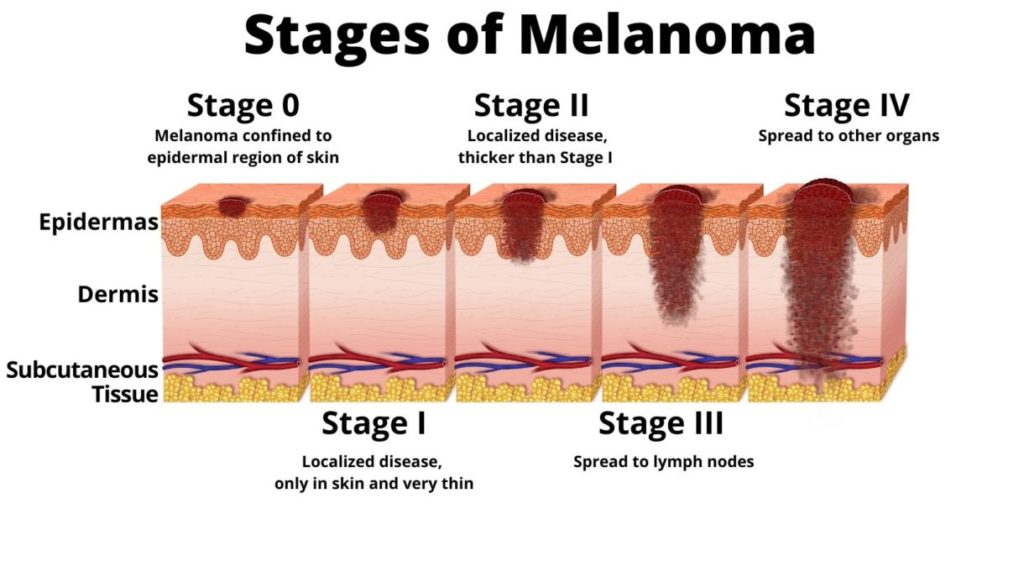

Your Stage of Melanoma at Diagnosis May Guide Your Treatment Decisions. A diagnosis of skin cancer is difficult. A diagnosis of melanoma, just plain melanoma, is more difficult. And a diagnosis of malignant melanoma may be the worst of all cancer diagnoses. I said “may be” as in this diagnosis could be the worst, depending on your stage at diagnosis.
Learn how melanoma stage, Breslow thickness, ulceration, and lymph-node involvement affect prognosis and survival for Stage 0–IV melanoma.
What Determines Melanoma Prognosis?
Melanoma prognosis depends primarily on how deeply the melanoma has invaded the skin, whether it has spread to nearby lymph nodes, and whether it has metastasized to distant organs. Breslow thickness, ulceration, lymph-node involvement and distant metastasis are important prognostic factors. The AJCC 8th edition staging system combines these findings to classify melanoma from Stage 0 through Stage IV.
Does melanoma stage determine prognosis?
Yes—but stage isn’t the only prognostic factor. Additional factors include:
- Breslow thickness
- ulceration
- lymph-node involvement
- distant metastases
- AJCC stage
- modern treatment
Malignant melanoma prognosis is heavily dictated by the stage at diagnosis, ranging from near 100% survival for stage 0 to 15%–35% for stage IV. Key prognostic factors include tumor thickness, ulceration, and the spread to lymph nodes or distant organs.
The survival statistics cited on this page come from clinical and population-based studies of melanoma patients. They should not be interpreted as evidence that complementary or integrative therapies improve melanoma survival. Evidence for most integrative approaches remains limited or preliminary.
Survival statistics are population estimates—not a prediction of how long a person will live.
Melanoma at a glance-
Risks– UV Exposure, HPV, Genetics, Skin Pigment, Moles, Immunosuppression, Previous Skin Cancer Diagnosis,
Symptoms- Mole, Shape (A,B, C,D,E), Itching, Bleeding,
Diagnosis- Visual Inspection, Skin Biopsy,
Prognosis– Staging, In-situ, I, II, III, IV, Five-year survival rates
Therapy– Conventional, Non-Conventional, Integrative, Alternative
Melanoma Stages 0–IV: What Each Stage Means
Use AJCC 8th edition terminology and clearly identify the staging system.
The NCI confirms that melanoma staging depends primarily on tumor thickness, lymph-node involvement, and distant spread.
The American Cancer Society’s current melanoma survival page, for example, uses SEER categories rather than AJCC stage I–IV:
- Localized: >99%
- Regional: 76%
- Distant: 36%
- All stages: 95%
What Determines Melanoma Prognosis?
Melanoma prognosis is mainly determined by how far the cancer has spread, the thickness of the tumor, and whether the skin surface is broken. [1]
Key Tumor Factors
- Breslow depth: How deep the cancer cells go into the skin, measured in millimeters. Thicker tumors mean a lower chance of cure.
- Ulceration: An open sore or breakdown on top of the melanoma, which means a higher risk and a worse outlook.
- Mitotic rate: How fast the cancer cells are dividing. A higher rate points to a more aggressive disease.
- Anatomic site: Where the melanoma is located on the body. Lesions on the trunk or head and neck often carry a higher risk than those on the arms or legs. [1, 2, 3]
Melanoma Stages 0–IV Explained
Stage 0 Melanoma
Stage 0 melanoma, also known as melanoma in situ, is an early, non-invasive form of skin cancer where abnormal cells are found only in the epidermis, which is the thin outer layer of the skin. [1, 2]
What is Stage 0 Melanoma?
- In situ meaning: The Latin phrase means “in place,” meaning the cancer has not moved.
- Depth: The abnormal cells stay in the top skin layer and do not reach the dermis, the second layer of skin.
- Spread: It has not spread to lymph nodes or other parts of the body.
Stage I Melanoma
Stage 1 melanoma is an early, localized skin cancer where the tumor has grown into the second layer of the skin (dermis) up to 2 mm thick, but has not spread to lymph nodes or distant parts of the body. [1, 2]
Key Characteristics
- Stage 1A: The tumor is thin (typically less than 1 mm thick) and may or may not be ulcerated (having broken skin).
- Stage 1B: The tumor is slightly thicker (1 mm to 2 mm) without ulceration, or under 1 mm with ulceration.
Stage II Melanoma
Stage 2 melanoma means the cancer is thicker and deeper in the skin, but it has not spread to nearby lymph nodes or other parts of the body. [1]
What Stage 2 Means
- Localized: The cancer stays at the original site in the skin.
- Invasive: It has grown past the top layer of skin (epidermis) and into the second layer (dermis).
Stage III Melanoma
Stage 3 melanoma is an advanced form of skin cancer where the cancer has spread from the original skin tumor into nearby lymph nodes, lymphatic channels, or nearby skin tissue, but has not yet reached distant organs. [1, 2]
What Stage 3 Means
- Regional spread: Cancer cells are found outside the primary mole or lesion in nearby regional structures. [1]
- No distant metastasis: The cancer has not spread to distant organs like the brain, lungs, or liver (the distant metastasis marker remains M0). [1]
Stage IV Melanoma
Stage 4 melanoma is the most advanced form of skin cancer, meaning the cancer has spread from its original site to distant parts of the body such as the lungs, liver, brain, bones, or distant lymph nodes. [1, 2]
Melanoma Survival Rates by Stage
Survival Rates by SEER Stage
- Stage 0 (In Situ): Nearly 100% 5-year survival rate because the abnormal cells stay in the outer skin layer.
- Stages I–II (Localized): More than 99% 5-year survival rate when the cancer stays in the primary site without spreading.
- Stage III (Regional): About 74% to 76% 5-year survival rate after spreading to nearby lymph nodes or structures.
The world of skin cancer is wide and complex. To be fair, I cannot blame you for not listening to whatever your oncologist has to say after he/she says, “you have skin cancer.” But keep in mind that your diagnosis can run the gamut, according to the study linked and excerpted below, from a five-year survival rate of over 90% to less than 10%, depending on your stage at diagnosis.
Your melanoma stage is one of the most important predictors of prognosis, but it is not the only factor. Breslow thickness, ulceration and other tumor characteristics can influence risk. After treatment, a stage-specific melanoma survivorship and follow-up plan can help monitor for recurrence and additional skin cancers.
- integrative therapies
- lifestyle
- monitoring
What Can Affect Melanoma Prognosis? An Evidence-Based Perspective
Not everything associated with better melanoma outcomes has been proven to cause better outcomes. Some factors—such as melanoma stage and Breslow thickness—are well-established predictors of prognosis. Others, including vitamin D status and lifestyle factors, are promising but have much less clinical evidence showing that changing them will reduce recurrence or improve survival.
| Factor or Strategy | Evidence Level | What the Evidence Shows | What This Means for Patients |
|---|---|---|---|
| Melanoma stage | 🟢 Established | Stage—based on tumor characteristics, lymph-node involvement and distant spread—is one of the strongest predictors of recurrence and survival. | Knowing your exact stage is essential for understanding prognosis and treatment options. |
| Breslow thickness, ulceration and lymph-node involvement | 🟢 Established | These tumor characteristics are established prognostic factors and are incorporated into melanoma staging and treatment decisions. | Ask your oncologist or dermatologist to explain these findings from your pathology report. |
| Stage-appropriate melanoma surveillance | 🟢 Established | Follow-up commonly includes regular skin and lymph-node examinations, with imaging or other testing used according to melanoma stage and individual recurrence risk. | Continued surveillance is important for detecting recurrence and additional melanomas as early as possible. |
| Skin self-examination and sun/UV protection | 🟢 Established | Melanoma guidelines recommend lifelong skin self-examination and avoiding excessive or unprotected UV exposure. | These measures are important parts of melanoma survivorship and prevention of additional skin cancers. |
| Adequate vitamin D status | 🟡 Promising observational evidence | Studies and meta-analyses have associated lower vitamin D levels with thicker melanomas and, in some studies, poorer melanoma outcomes. However, this does not prove that vitamin D supplementation improves melanoma survival. | Discuss testing for vitamin D deficiency with your doctor. Correcting deficiency may be reasonable, but vitamin D should not be considered a melanoma treatment. |
| Exercise, healthy diet and weight management | 🟠 Preliminary / indirect evidence | These behaviors support cardiovascular health, metabolic health, physical function and overall cancer survivorship, but evidence that they specifically prevent melanoma recurrence or improve melanoma-specific survival remains limited. | They are reasonable components of a healthy survivorship plan, but should complement—not replace—melanoma treatment and surveillance. |
| Supplements and other integrative therapies | 🟠 Preliminary integrative evidence | Laboratory, mechanistic and observational studies suggest potential benefits for some nutrients and compounds, but clinical evidence demonstrating improved melanoma survival is generally limited. Some supplements may also interact with cancer treatments. | Evaluate supplements individually with your oncology team rather than assuming that “natural” means effective or risk-free. |
PeopleBeatingCancer Interpretation
🟢 Established evidence — Supported by clinical guidelines and substantial clinical evidence.
🟡 Promising observational evidence — Human studies show an association, but they cannot establish that changing the factor will improve melanoma outcomes.
🟠 Preliminary evidence — Biologically plausible or supported by early, indirect, laboratory or limited clinical research, but not established as a melanoma treatment.
The Bottom Line
Melanoma stage remains the foundation of prognosis. Breslow thickness, ulceration, lymph-node involvement and metastatic spread have far stronger evidence as prognostic factors than any diet, supplement or integrative therapy.
At the same time, melanoma survivors can focus on the factors they can influence: keeping follow-up appointments, performing regular skin self-examinations, protecting their skin from excessive UV exposure, correcting nutritional deficiencies when appropriate, exercising, eating a healthy diet and discussing supplements with their oncology team.
The important distinction is between a factor that is associated with better outcomes and an intervention that has actually been proven to improve outcomes.
I am a long-term cancer survivor and cancer coach. I field questions from cancer patients, survivors and caregivers daily. Many of the questions I’m asked are from cancer patients who don’t know their stage at diagnosis.
The combination of therapies for malignant skin cancer- both conventional (FDA-approved) and evidence-based but not FDA-approved- is extensive. The five-year survival averages listed below take into account only conventional therapies. Not evidence-based Integrative, Complementary and Botanical therapies.
Have you been diagnosed with either melanoma or non-melanoma skin cancer? Scroll down the page, post a question or a comment and I will reply ASAP.
To learn more about melanoma aka skin cancer, go to Skin Cancer: Need-to-Know
Thank you
David Emerson
- Cancer Survivor
- Cancer Coach
- Director PeopleBeatingCancer
Concepts Central to Managing Your Cancer-
- Integrative Oncology: Combining Conventional and Natural Cancer Therapies
- Complementary Cancer Therapies: Evidence-based
- Managing Cancer Treatment Side Effects: An Evidence-Based Guide to Prevention, Relief, and Recovery
- Cancer Financial Toxicity: Costs, Medical Debt, Insurance, Financial Assistance, and Survivorship
- Melanoma Surgery: What Patients Need to Know
- Melanoma In Situ: Residual Melanoma In-Situ After Mohs?
What are the stages of melanoma?
Recommended Reading:
- Non-Melanoma Skin Cancer Risk Increases From Radiation
- Preventing Non-Melanoma Skin Cancer Relapse
- How to Identify Skin Cancer in 5 Steps
- Skin Cancer, Vitamin D3 and Sunlight
Malignant Melanoma Staging
Melanoma Stages Explained (0–IV)**
Stage IA:
- Lesions ≤1 mm in thickness with no evidence of ulceration or metastases (T1aN0M0) are associated with a 5-y survival rate of ~97%
Stage IB:
- Lesions ≤1 mm in thickness with ulceration noted but without lymph node involvement (T1bN0M0) or lesions 1.01-2 mm in thickness without ulceration or lymph node involvement (T2aN0M0) are associated with a 5-y survival rate of ~92%
Stage IIA:
- Melanomas >1 mm but ≤2 mm in thickness with no evidence of metastases but with evidence of ulceration (T2bN0M0) or lesions 2.01-4.0 mm in thickness without ulceration or lymph node involvement (T3aN0M0) are associated with an overall 5-y survival rate of ~81%
Stage IIB:
- Melanomas 2.01-4 mm in thickness with ulceration but no lymph node involvement (T3bN0M0) or lesions >4 mm in thickness without ulceration or lymph node involvement (T4aN0M0) are associated with a 5-y survival rate of ~70%
Stage IIC:
- Lesions >4 mm in thickness with ulceration but no lymph node involvement (T4bN0M0) are associated with a 5-y survival rate of ~53%
Stage IIIA:
- Patients with any-depth lesion, no ulceration, and 1 positive (micrometastatic) lymph node (T1-4aN1aM0) have a 5-y survival rate of ~70%
- T1-4aN2aM0 lesions (any-depth lesion, no ulceration, but 2-3 nodes positive for micrometastasis) are associated with a 5-y survival rate of 63%
Stage IIIB:
- Patients with any-depth lesion, positive ulceration, and 1 lymph node positive for micrometastasis (T1-4bN1aM0) or 2-3 nodes positive for micrometastasis (T1-4bN2aM0) have a 5-y survival rate of 50-53%
- Patients with any-depth lesion, no ulceration, and 1 lymph node positive for macrometastasis (T1-4a, N1b, M0) or 2-3 nodes positive for macrometastasis (T1-4aN2bM0) have a 5-y survival rate of 46-59%
Stage IIIC:
- Patients with any-depth lesion, positive ulceration, and 1 lymph node positive for macrometastasis (T1-4bN1bM0); 2-3 nodes positive for macrometastasis (T1-4bN2bM0); or ≥4 metastatic lymph nodes, matted lymph nodes, or in-transit met(s)/satellite(s) have a 5-y survival rate of ~40%
Stage IV:
- Melanoma metastatic to skin, subcutaneous tissue, or lymph nodes with normal LDH level (M1a) is associated with a 5-y survival rate of ~15%-20%
- M1b disease (metastatic disease to lungs with normal LDH level) has a 5-y survival rate of 7%
- M1c disease (metastatic disease to all other visceral organs and normal LDH level or any distant disease with elevated LDH level) is associated with a 5-y survival rate of 10%
Mitotic rate assessment
For mitotic rate assessment, the pathologist counts the number of cells in a certain amount of melanoma tissue that are in the process of dividing. A higher mitotic rate means that the cancer is more likely to grow and spread. The mitotic rate is used to stage thin melanoma.
To learn more about melanoma staging-
Cross-site authority: